This story belongs to Devyani Rajan. We're sharing it with her permission, with full credit, and with a link to her original substack post. She wore TheRec's Altitude windcheater on her self-supported Roopkund trek in 2026 — through a storm at Patar Nachani, a freezing night on a stone floor, and a summit push that started in darkness at 2:30am. We didn't ask her to write about it. She did, and the piece she wrote tells the gear story better than any spec sheet ever could.
Read her full post: The Mountain Always Wins: Roopkund Trek on Devyani Rajan's substack.

What Roopkund actually asked of her gear
Roopkund is not a guided package trek when you do it the way Devyani did it. Most people tackle it with a support crew and mules carrying the load. She did it self-supported — eight people, each carrying their own rations, cooking equipment, tent, and gear. Every kilogram she packed, she carried up to the slopes below the lake at over 4,500 metres.
That's the first thing to understand about this story. The Altitude wasn't being tested in an interview-style staged environment. It was being tested as one piece in a stack where every gram mattered, where there was no backup jacket in a porter's bag, and where conditions had no negotiation built in.
Day 3: the storm at Patar Nachani
The day that defined the trek, in Devyani's own words:
"The wind hit us without warning — ferocious, blinding, carrying pellets of snow that stung every inch of exposed skin. You couldn't open your eyes fully. You couldn't hear the person right next to you."
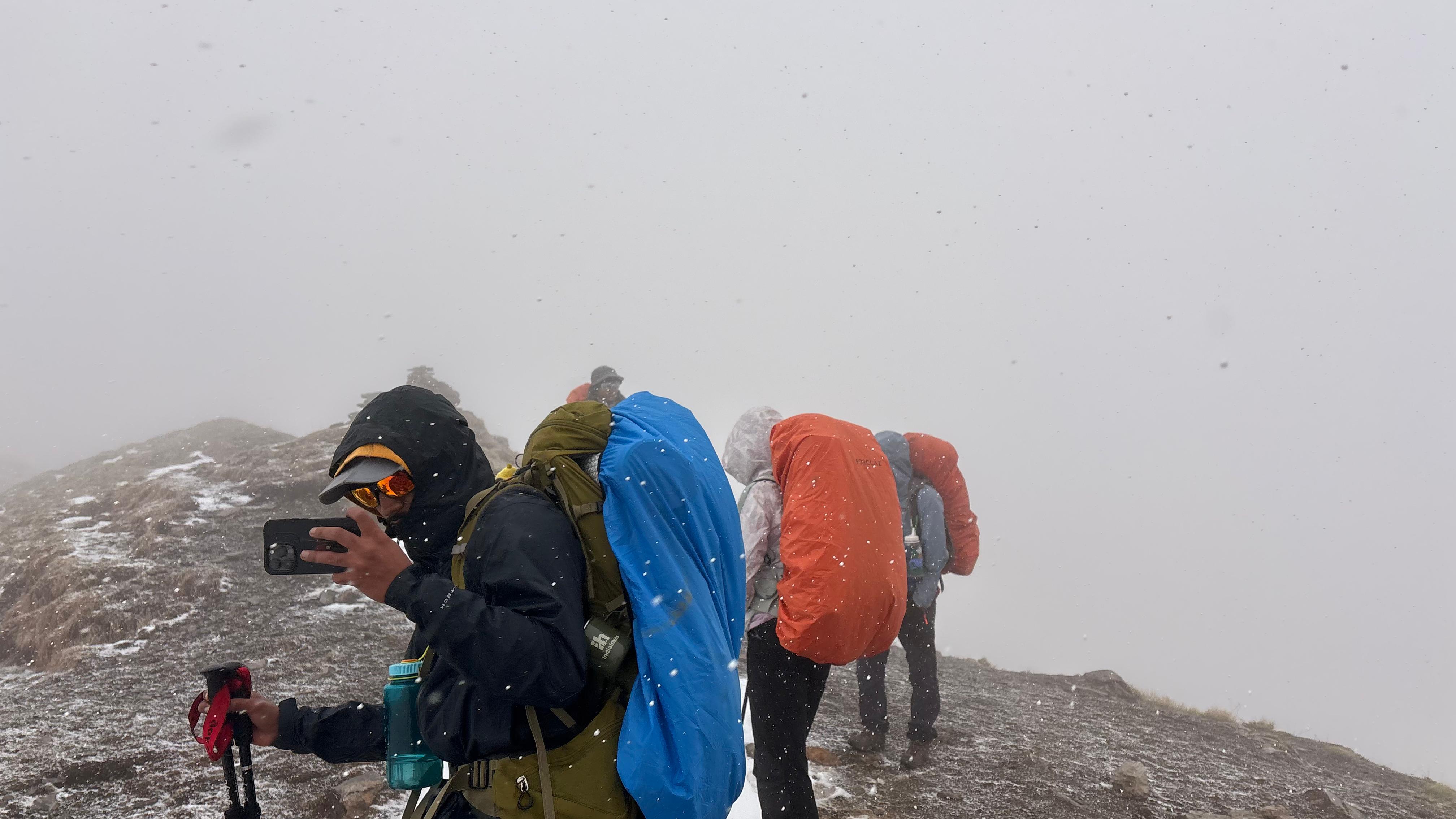
This is the kind of weather Indian outdoor gear is rarely written about handling. Wind sharp enough that you cannot open your eyes. Snow being driven into exposed skin. The visibility cut down to the back of the person ahead of you. They reached the huts at Patar Nachani — three huts on the trail, every group on the route trying to get into them — and made it inside. That night, all eight of them slept in a single line on a cold stone floor. Outside, the snow and wind raged.
The Altitude wasn't the only layer protecting her, of course — it was an outer shell over insulation. What it had to do was hold against driven wind, repel the wet snow before it soaked through to the layers underneath, and keep functioning while she covered ground at altitude under load. The fact that the team got to Patar Nachani at all, in those conditions, says something about the gear stack she was running.
Day 4: a birthday on the snow
"I woke up to silence and briefly clear skies. Fresh powdered snow blanketed everything around us, and the peaks I'd only glimpsed from a distance were suddenly right there — close enough to feel unreal. It was my 24th birthday, and I felt genuinely privileged to be standing in the middle of it all."

That season, no team had made it beyond Patar Nachani. The continuous snowfall the previous day made the next stage too risky to attempt in daylight. They waited. The group spent the day hiking around camp, eating popcorn, making plans for a 1am wake-up call if the sky cleared. It cleared.
The summit push: 2:30am to 10am
They moved out at 2:30am. The first ninety minutes of the climb, Devyani says, was nothing but her feet in a small circle of headlamp light — left foot, right foot, the trail existing only in that tiny illuminated patch. Then, at Kalu Vinayak, she looked up.
"Trishul and Nanda Ghunti were glowing. Not just visible — glowing, bathed in cold white moonlight, utterly silent and utterly indifferent to the fact that I was gasping for breath."
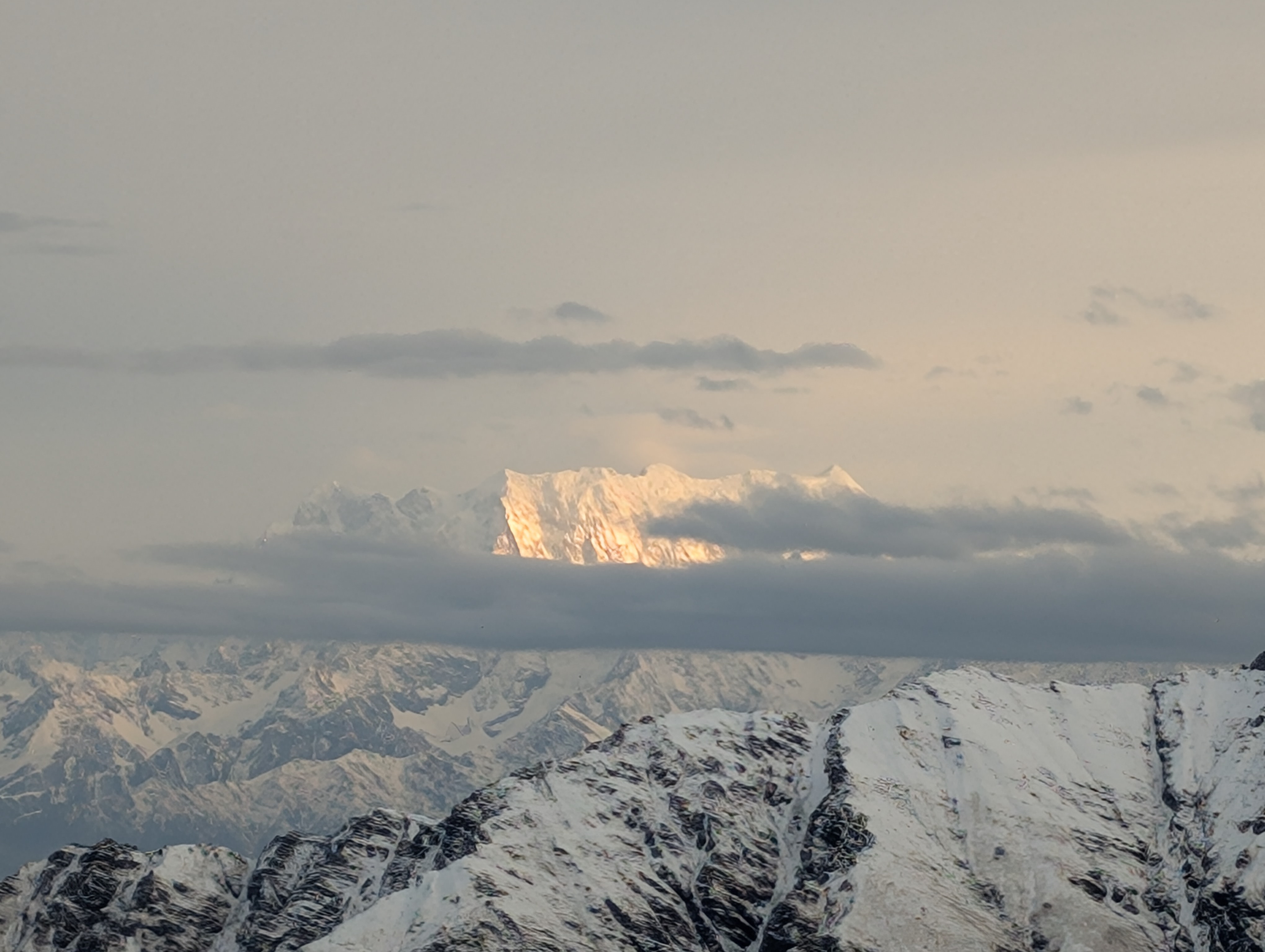
Beyond Kalu Vinayak, the trail transformed from rocky boulders into vast snow fields. No one had broken trail that season — they were doing it as they went, four steps of effort for one step of progress. At one point Devyani found herself on what she describes as a 70-degree snow face, gripping a rope anchored with an ice axe, with the drop falling sharply into the valley below.
The hard turnaround time was 10am. As if on cue, clouds rolled in like a curtain being drawn. They turned around.
"The mountain had made its decision. We had no choice but to turn around."
What this tells us about The Altitude
The Altitude windcheater isn't an alpine shell. It isn't a hardshell rated to expedition use. It's a packable, lightweight windcheater in 100% recycled nylon with a water-repellent DWR finish, UPF 50+ certification, and a weight that disappears in a hip pocket. The brief was light, packable, and capable of handling Indian outdoor conditions — Himalayan trekking, trail running, monsoon weather, summer UV. It was never marketed as a polar expedition piece.
What Devyani's trek demonstrates is that the brief covers more than the brief was written for. The Altitude held up across:
-
Sustained high winds with driven snow at Patar Nachani — the storm day
-
Pre-dawn summit push starting at -5°C to -10°C under headlamp at altitude
-
4,500m+ elevation with intense UV reflection from fresh snow
-
Self-supported backpacking load over multiple days, packed and unpacked repeatedly
-
Wet snow followed by cold dry conditions — the full Indian Himalayan weather cycle in a single trek
That's not what the gear was designed for, strictly speaking. It's what the gear did when a real Indian trekker took it into real conditions and asked it to perform.
The honest framing
Devyani didn't summit. The mountain turned them back at 10am at the agreed turnaround time, with clouds rolling in fast. They were close — they could see the outline of the ridge above the lake. They didn't reach it.
This is part of the story, not a footnote to it. Her own framing of the trek closes with this:
"In the Himalayas, the story of David and Goliath doesn't play out the way you'd hope. The Goliath always wins. The mountain decides who reaches the top and when. All you can do is show up with humility, give everything you have, and be grateful for what it allows you to see... The mountain humbled me. And it set me free."
This isn't the language of a brand campaign. It's the language of someone who's been into real mountains and come back with the right relationship to them. That kind of voice is rare in Indian outdoor content. It deserves to be amplified, not packaged.
What The Altitude was actually built for
If you're considering The Altitude for a Himalayan trek, an Indian altitude race, or any Indian outdoor experience where weight, packability, and wind resistance matter together, here's the honest spec breakdown:
-
100% recycled nylon shell — same fabric class used by global outdoor brands for their packable windcheaters
-
UPF 50+ certified across the panel — protects arms from altitude UV when worn at exposed elevations like Devyani's Roopkund slopes
-
DWR water-repellent finish — sheds light snow, mist, and pre-monsoon showers, won't soak through immediately in moderate rain
-
Packs into a chest pocket — relevant for runners and trekkers who layer in and out across the day
-
Ultralight construction — weight that doesn't matter on the back, but matters when worn at altitude
It's not the right piece for: sustained heavy rain (you want a hardshell), polar expedition cold (you want technical insulation under a heavyweight shell), or as a standalone layer in winter Himalayan summits (you want it as part of a layering system, the way Devyani used it).
It is the right piece for: Himalayan treks where weight matters, race day cold starts at altitude, Indian monsoon trail running, summer UV protection on arms, and packable wind protection across the full range of Indian outdoor conditions. See The Altitude windcheater.
Read Devyani's full story
This article covers the gear angle. Devyani's full substack post covers the trek the way it deserves to be told — the village kitchens, the morning Nanda Ghunti view, the way the group huddled in a single hut, the 70-degree snow face in the dark, the long walk back, and what the mountain taught her about humility and freedom.
Read it here: The Mountain Always Wins: Roopkund Trek — Devyani Rajan
All photographs in this article are by Devyani Rajan and are used with her permission. The Altitude windbreaker featured was a personal purchase, not gifted or sponsored. We learned about her trek when she shared her post — we asked if we could write about the gear story, and she said yes.


